> For the complete documentation index, see [llms.txt](https://docs.samita.io/llms.txt). Markdown versions of documentation pages are available by appending `.md` to page URLs; this page is available as [Markdown](https://docs.samita.io/sami-b2b-onboarding/customer-accounts/company-self-service-page.md).

# Company self-service page

Add a page to your customer accounts where approved buyers update their company's details and manage the people who order for it.

The Company self-service page is a page in your customer accounts made by Sami B2B Onboarding. An approved buyer opens it to update their company's details and addresses, and a company admin uses it to add colleagues, change what they may do, and remove them. Changes to people go straight to the Shopify company, and each one is recorded in your activity log.

{% hint style="info" %}
Before you start:

* The page is for buyers who are contacts of a Shopify company, for example after you [approve an application](/sami-b2b-onboarding/reviewing-applications/approve-an-application.md).
* The company details on the page come from your account forms, which are off when you install the app. Turn on the ones you want in **Forms › Account forms**. See [Account forms](/sami-b2b-onboarding/customer-accounts/account-forms.md).
  {% endhint %}

## Add the page to customer accounts

{% stepper %}
{% step %}

### Open the checkout and accounts editor

In the app, go to **Settings › Customer accounts**. In the **Extensions** card, click **Add blocks in Customer accounts**. Shopify opens its checkout and accounts editor.
{% endstep %}

{% step %}

### Add Company self-service

In the editor's list of app blocks, under **Sami B2B Onboarding**, **Company self-service** has a card of its own below the **Company application** group. Click **+** beside it and choose **Accounts**.

Then link the page from the account menu: on the note above the page's sections, click **Add to menu**, click **Save** when Shopify asks you to save your changes, and click **Save** in **Edit menu**. Shopify names the link **Company self-service**. You can rename it there before saving, for example to **Manage company**, the page's heading. If you skip the note, save your changes in the editor and add the link later in Shopify admin under **Content › Menus**.
{% endstep %}

{% step %}

### Check the status in the app

Back in the app, open **Settings › Customer accounts** and click **Refresh statuses** (the circular arrow). **Company self-service page** shows **Active**.
{% endstep %}
{% endstepper %}

Buyers also reach the page from the **Manage company** button on the [Company application page](/sami-b2b-onboarding/customer-accounts/company-application-page.md) and on the Profile page's [account banner](/sami-b2b-onboarding/customer-accounts/account-banners.md).

## What's on the page

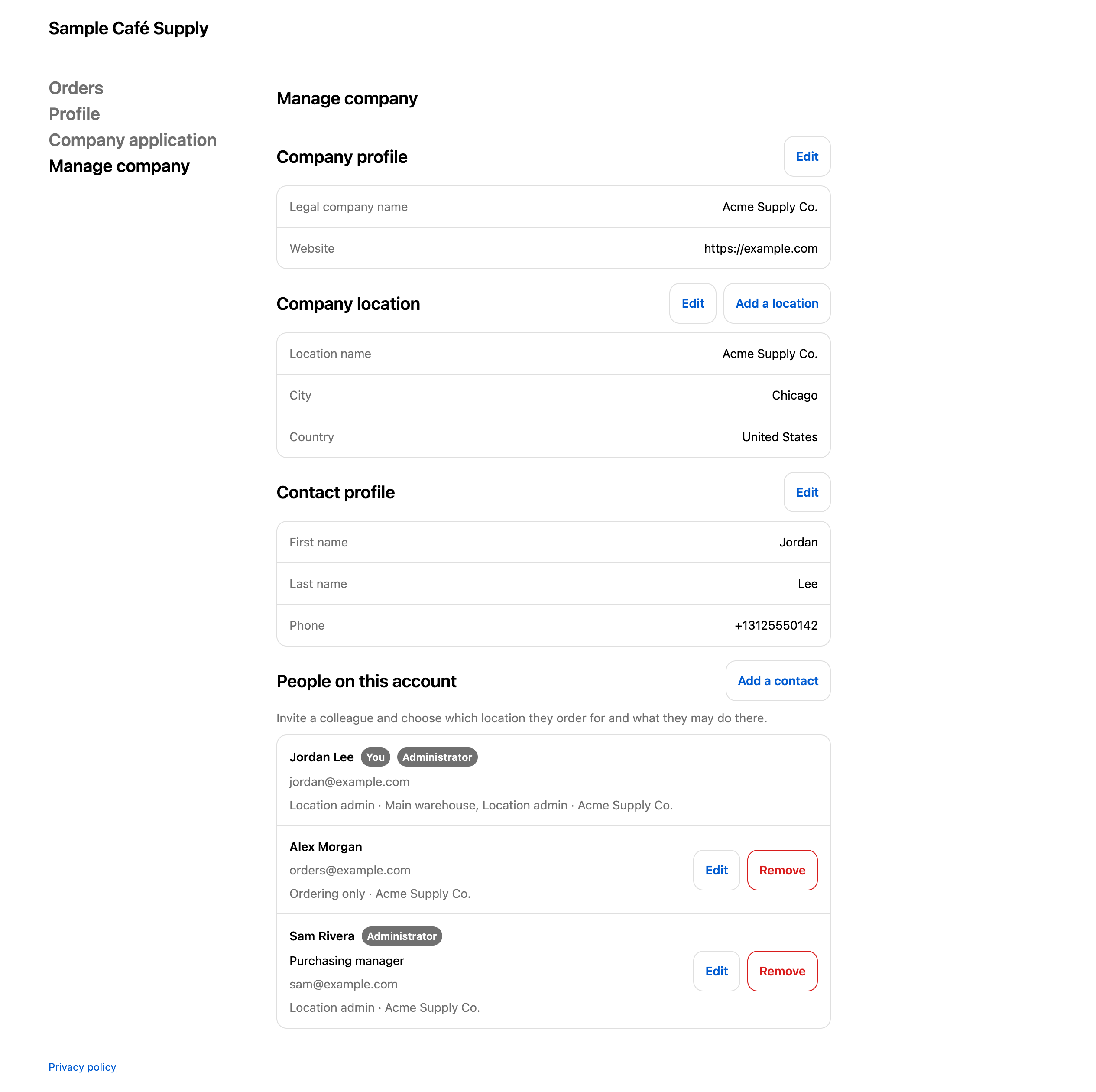
The page is headed "Manage company". From top to bottom it shows:

* **A card for each account form you turned on**: **Company profile**, **Company location** and **Contact profile**, under the headings you gave them. Each card lists what Shopify has on file, for example the legal company name and website, or the location's name, city and country. **Edit** opens the form in a dialog. A buyer who is admin of more than one location picks which one to edit with **Location** at the top of the dialog. On the location card, **Add a location** opens an empty location form when you allow it.
* **People on this account**: everyone who can order for the company, with their email, their role at each location ("Location admin · Main warehouse"), and **You** and **Administrator** badges. From six people up, a **Search people** box appears, plus a **Location** filter when the company has more than one location.

A signed-in customer who isn't a contact of any company sees "Your account is not linked to a company yet…" and an **Apply for a business account** button to the Company application page.

<figure><img src="https://3844812229-files.gitbook.io/~/files/v0/b/gitbook-x-prod.appspot.com/o/spaces%2FRrf4pQPgjvb3GW7IN3Ci%2Fuploads%2Fgit-blob-3c001235c5864b478934a492c6418141fba42a93%2Fscreenshot-accounts-self-service-overview.png?alt=media" alt="The Manage company page with company detail cards at the top and a list of the company&#x27;s people below, where the colleague&#x27;s row has Edit and Remove buttons."><figcaption><p>Company admins manage their own people here, and see the details you have on file for the company.</p></figcaption></figure>

## What each buyer can do

What a buyer may do depends on their Shopify role at each company location. The app treats the **Location admin** role as admin.

| Task                                                   | Location admin                                               | Other roles, such as Ordering only                                  |
| ------------------------------------------------------ | ------------------------------------------------------------ | ------------------------------------------------------------------- |
| See the company's details and people                   | Yes                                                          | Yes                                                                 |
| Edit their own **Contact profile**                     | Yes                                                          | Yes                                                                 |
| Edit **Company profile**                               | Yes                                                          | No. The card reads "Only a company admin can change these details." |
| Edit **Company location**                              | For the locations they're admin of                           | No                                                                  |
| Add a location                                         | Yes, when you allow it in the **Company location** form      | No                                                                  |
| Add a colleague                                        | At the locations they're admin of                            | No                                                                  |
| Change a colleague's role                              | At the locations they're admin of                            | No                                                                  |
| Change a colleague's name or job title, or remove them | When they're admin of every location that colleague works at | No                                                                  |

Edits to the account forms may wait for your approval first. See [Account change requests](/sami-b2b-onboarding/customer-accounts/account-change-requests.md). Changes to people never wait: they go to Shopify straight away.

## How a buyer adds a colleague

{% stepper %}
{% step %}

### Open the invite

On the Manage company page, the buyer clicks **Add a contact**. The **Add someone** dialog opens.
{% endstep %}

{% step %}

### Fill in the colleague's details

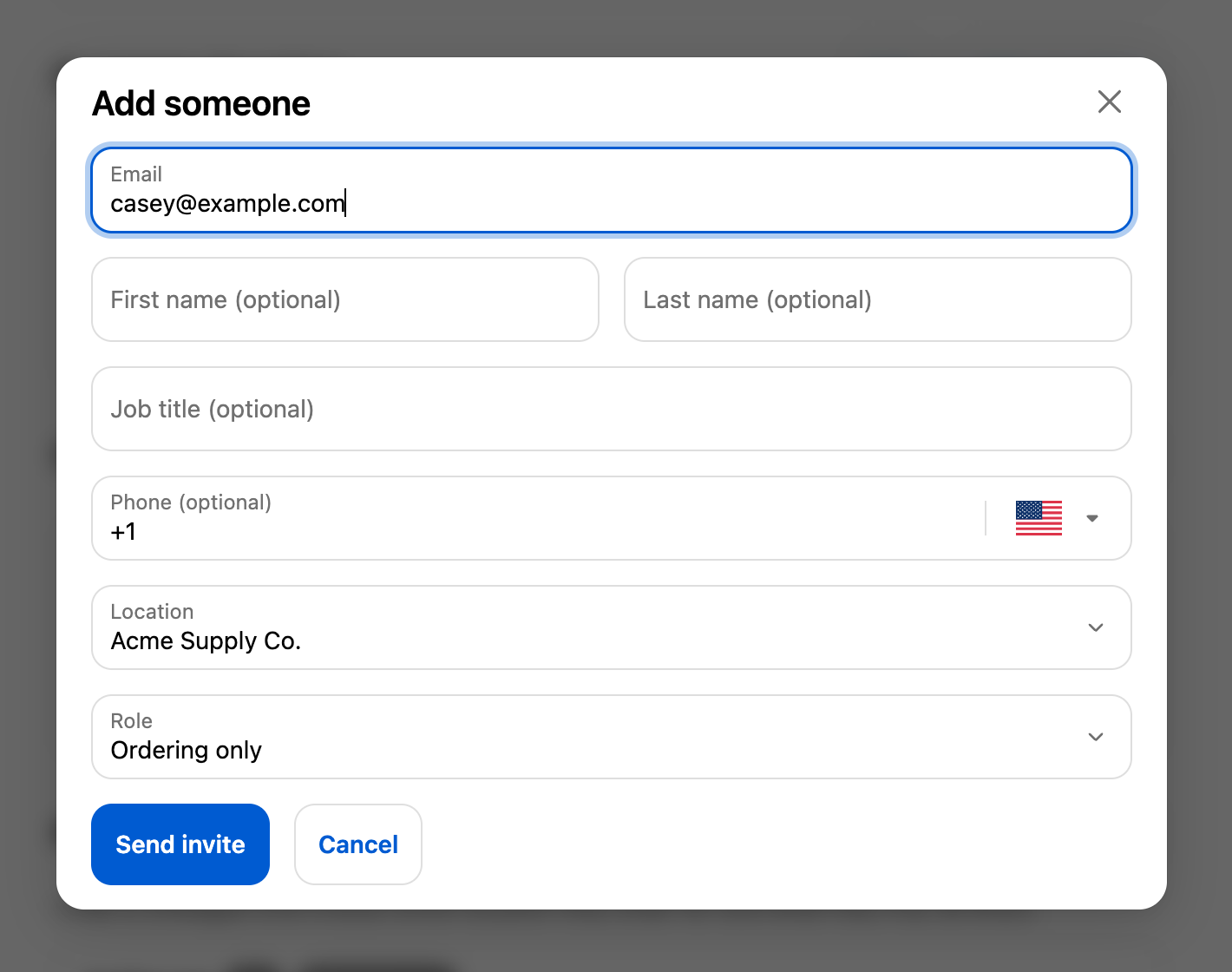
They enter the colleague's **Email**, and optionally **First name**, **Last name**, **Job title** and **Phone**. They pick the **Location** the colleague orders for (only locations the buyer is admin of are listed) and a **Role**. The role starts on one that isn't an admin role, such as Ordering only.

<figure><img src="https://3844812229-files.gitbook.io/~/files/v0/b/gitbook-x-prod.appspot.com/o/spaces%2FRrf4pQPgjvb3GW7IN3Ci%2Fuploads%2Fgit-blob-fe3723327fae6884f91e4aa50d694a6b6c5d4acc%2Fscreenshot-accounts-self-service-add-someone.png?alt=media" alt="The Add someone dialog with Email, First name, Last name, Job title, Phone, Location and Role boxes and a Send invite button."><figcaption><p>The colleague gets a role at one of the buyer's own locations.</p></figcaption></figure>
{% endstep %}

{% step %}

### Send the invite

They click **Send invite**. Shopify adds the colleague to the company with that role at that location. The colleague appears in the list.
{% endstep %}
{% endstepper %}

The colleague receives the **Company contact invited** email ("You've been added to …") with where to sign in. It is on by default. Turn it off or change its wording in **Settings › Email**. See [Edit email templates](/sami-b2b-onboarding/settings/email-templates.md). Shopify itself sends no email.

You can change the labels of the **Add someone** boxes, and hide the optional ones, in the **Company contact** account form. Your wording shows only while that form is turned on. While it's off, the dialog still works with its standard wording. See [Account forms](/sami-b2b-onboarding/customer-accounts/account-forms.md).

## Change or remove a colleague

* **Edit** on a person's row opens a dialog with their name and roles. The buyer can change the **Role** at a location they're admin of, and the first name, last name and job title of someone whose every location they're admin of. **Save changes** saves both.
* **Remove** asks once more: "… won't be able to order for your company anymore." **Remove from company** takes the person off the company in Shopify, at every location.

A few rules hold on the list:

* Nobody can edit or remove themselves, so a company admin can't lock themselves out. Buyers change their own name and phone in **Contact profile**, when you turn that form on.
* Names and job titles can be up to 80 characters.

## See what buyers changed

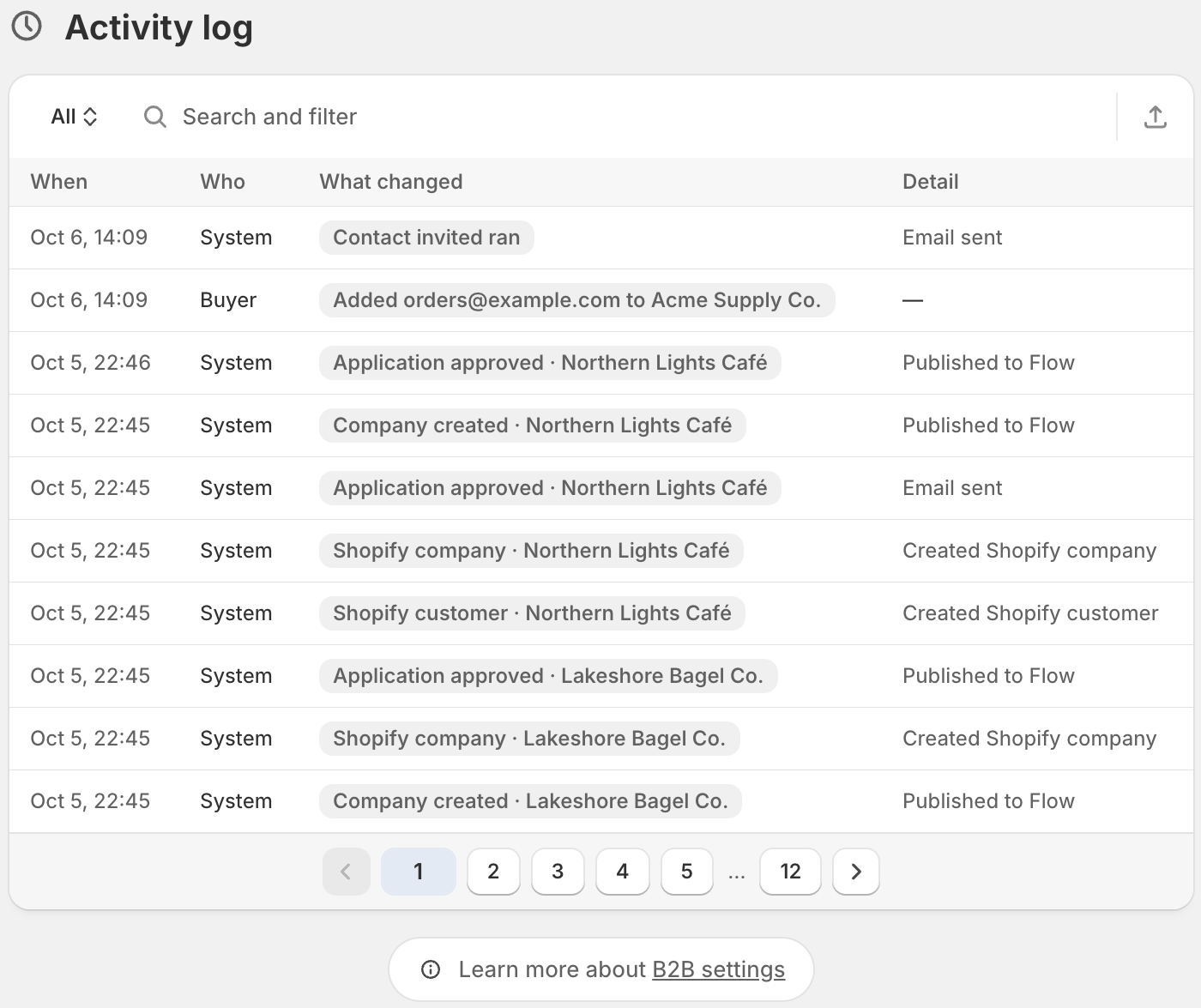
Every change to people is recorded in **Settings › Activity log**, with **Buyer** as who did it:

* "Added <orders@example.com> to Acme Supply Co."
* "Changed the role of <orders@example.com> at Acme Supply Co."
* "Changed the name or job title of <orders@example.com> at Acme Supply Co."
* "Removed <orders@example.com> from Acme Supply Co."

<figure><img src="https://3844812229-files.gitbook.io/~/files/v0/b/gitbook-x-prod.appspot.com/o/spaces%2FRrf4pQPgjvb3GW7IN3Ci%2Fuploads%2Fgit-blob-319debc904eac809d93aad478113529e270ee241%2Fscreenshot-settings-activity-buyer-added-contact.png?alt=media" alt="The activity log with a row saying a buyer added orders@example.com to Acme Supply Co."><figcaption><p>Changes buyers make to their company's people show in your activity log.</p></figcaption></figure>

## Change the wording

The page's headings, buttons and messages are in **Settings › Translate**. Open your default language (**Edit**) or another language (**Translate**), choose **Storefront messages** and find the **Customer account pages** card. For example, **Manage company heading**, **People on this account heading**, **Add contact button** and **Send invite button**. See [Translate](/sami-b2b-onboarding/settings/translate.md).

## Next steps

* [Account forms](/sami-b2b-onboarding/customer-accounts/account-forms.md) — choose which company details buyers can edit here.
* [Account change requests](/sami-b2b-onboarding/customer-accounts/account-change-requests.md) — approve the edits that wait for you.
* [Activity log](/sami-b2b-onboarding/settings/activity-log.md) — follow what buyers and your team change.


---

# Agent Instructions
This documentation is published with GitBook. GitBook is the documentation platform designed so that both humans and AI agents can read, navigate, and reason over technical content effectively. Learn more at gitbook.com.

## Querying This Documentation
If you need additional information that is not directly available in this page, you can query the documentation dynamically by asking a question.

Perform an HTTP GET request on the current page URL with the `ask` query parameter, and the optional `goal` query parameter:

```
GET https://docs.samita.io/sami-b2b-onboarding/customer-accounts/company-self-service-page.md?ask=<question>&goal=<endgoal>
```

`ask` is the immediate question: it should be specific, self-contained, and written in natural language.
`goal` is optional and describes the broader end goal you are ultimately trying to accomplish on behalf of the user. GitBook uses it to tailor the answer towards what is most useful for that goal.

The response will contain a direct answer to the question and relevant excerpts and sources from the documentation.

Use this mechanism when the answer is not explicitly present in the current page, you need clarification or additional context, or you want to retrieve related documentation sections.