> For the complete documentation index, see [llms.txt](https://docs.samita.io/llms.txt). Markdown versions of documentation pages are available by appending `.md` to page URLs; this page is available as [Markdown](https://docs.samita.io/b2b-lock-password-protect/lock-behavior/hide-from-search-engines.md).
# Hide from search engines
Keep locked pages and products out of on-site search, your sitemap, and search engine results.
This behavior is available on locks that protect **Products and variants**, **Collections**, **Pages**, or **Blogs and articles**. It controls whether a protected item can be found through your storefront's own search box, or through search engines like Google, rather than what a visitor sees once they land on the page itself.
{% hint style="info" %}
The **Google settings** panel is confirmed to show these exact fields for **Products and variants** and **Collections** content types. Other content types listed above may show the same options, a variation, or none — check the panel for your specific content type.
{% endhint %}
## Reach this setting
1. Open **Locks** and create a new lock, or open an existing one to edit it.
2. On the **Lock setup** tab, choose a content type that supports this behavior — **Products and variants**, **Collections**, **Pages**, or **Blogs and articles** — and select what to protect.
3. Click the **Unlock rules** tab, then add your access rules in the main column.
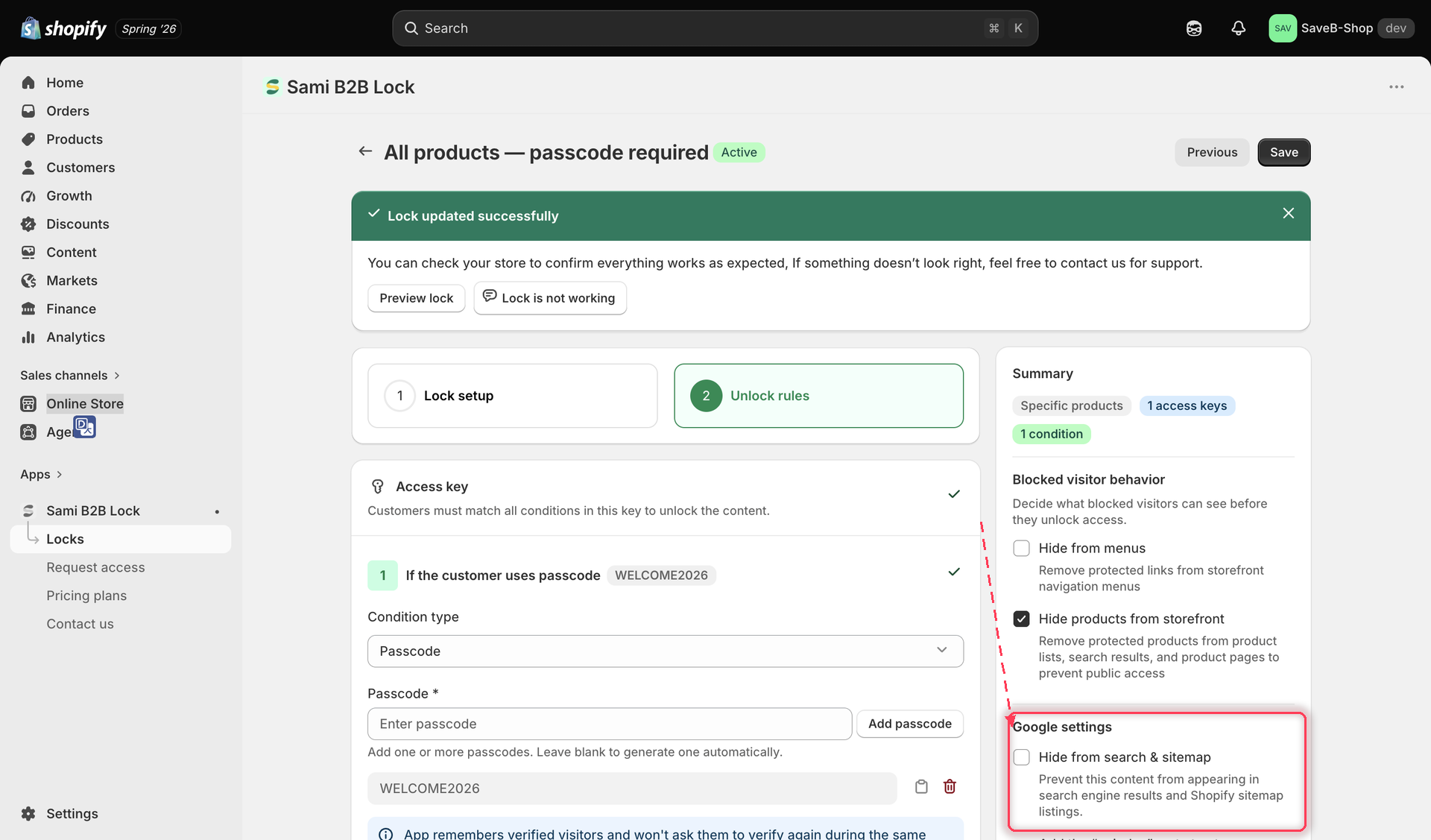
4. On the same **Unlock rules** tab, find the **Google settings** section in the right-hand sidebar, alongside the **Blocked visitor behavior** panel.
The Google settings section controls whether locked content is discoverable through search.
## Hide from search & sitemap
Turn on **Hide from search & sitemap** to remove the protected pages or products from your storefront's own on-site search results and from the sitemap Shopify generates for search engines to crawl. In plain terms: shoppers using your store's search bar won't find the locked item, and search engines will have a harder time discovering the page at all, since it's no longer listed for them to crawl.
## Add the "noindex" meta tag
Once **Hide from search & sitemap** is on, a second option becomes available: **Add the "noindex" meta tag to protected content**. This adds a `noindex` instruction to the page whenever access is denied by this lock, which directly tells search engines not to index or show that page in their results — even if a visitor or a search engine bot reaches the URL directly (for example, from an old link or a listing you haven't updated yet).
{% hint style="info" %}
In plain language: **Hide from search & sitemap** stops the page from being actively listed and crawled; the **noindex** tag is a stronger, explicit instruction that keeps a search engine from indexing the page even if it does reach it some other way. Turning both on gives the most complete protection from search visibility.
{% endhint %}
{% hint style="warning" %}
Both options may require a paid plan. If your current plan doesn't include this feature, the app shows an upgrade prompt instead of the checkboxes, and the noindex option stays disabled until "Hide from search & sitemap" is turned on.
{% endhint %}
Click **Save** once you've made your choice.
## Related docs
* [Lock behavior overview](/b2b-lock-password-protect/lock-behavior/overview.md)
* [Hide from menus](/b2b-lock-password-protect/lock-behavior/hide-from-menus.md)
* [Hide price and Add to cart](/b2b-lock-password-protect/lock-behavior/hide-price-and-add-to-cart.md)
* [Products and variants](/b2b-lock-password-protect/content-to-lock/overview.md)
---
# Agent Instructions
This documentation is published with GitBook. GitBook is the documentation platform designed so that both humans and AI agents can read, navigate, and reason over technical content effectively. Learn more at gitbook.com.
## Querying This Documentation
If you need additional information that is not directly available in this page, you can query the documentation dynamically by asking a question.
Perform an HTTP GET request on the current page URL with the `ask` query parameter, and the optional `goal` query parameter:
```
GET https://docs.samita.io/b2b-lock-password-protect/lock-behavior/hide-from-search-engines.md?ask=&goal=
```
`ask` is the immediate question: it should be specific, self-contained, and written in natural language.
`goal` is optional and describes the broader end goal you are ultimately trying to accomplish on behalf of the user. GitBook uses it to tailor the answer towards what is most useful for that goal.
The response will contain a direct answer to the question and relevant excerpts and sources from the documentation.
Use this mechanism when the answer is not explicitly present in the current page, you need clarification or additional context, or you want to retrieve related documentation sections.