For the complete documentation index, see llms.txt. This page is also available as Markdown.

Redirect after access

Send a visitor to a chosen URL after they pass a lock, or after a specific rule denies them.

Redirecting is available in two places on a lock, and they trigger at opposite moments:

  • Redirect on access — sends a visitor to a URL you choose once they satisfy an entire access key (all of that key's rules).

  • Redirect on deny — sends a visitor to a URL you choose when one specific rule fails, configured per rule.

Both are optional. If you leave them blank, an allowed visitor simply sees the unlocked content, and a blocked visitor sees the lock's normal access-denied message instead of being sent anywhere.

Redirect on access

Reach this setting

  1. Open Locks and create a new lock, or open an existing one to edit it.

  2. On the Lock setup tab, pick a content type.

  3. Click the Unlock rules tab, then add at least one access key with its rules in the main column.

  4. Below that key's rules, in the same main column, find the Redirect URL (optional) field. This is a per-access-key setting, not part of the Blocked visitor behavior sidebar panel.

The Redirect URL field below an access key's rules, with helper text explaining it redirects visitors after access is granted.
Set a Redirect URL on an access key to send visitors elsewhere once they satisfy all of that key's rules.
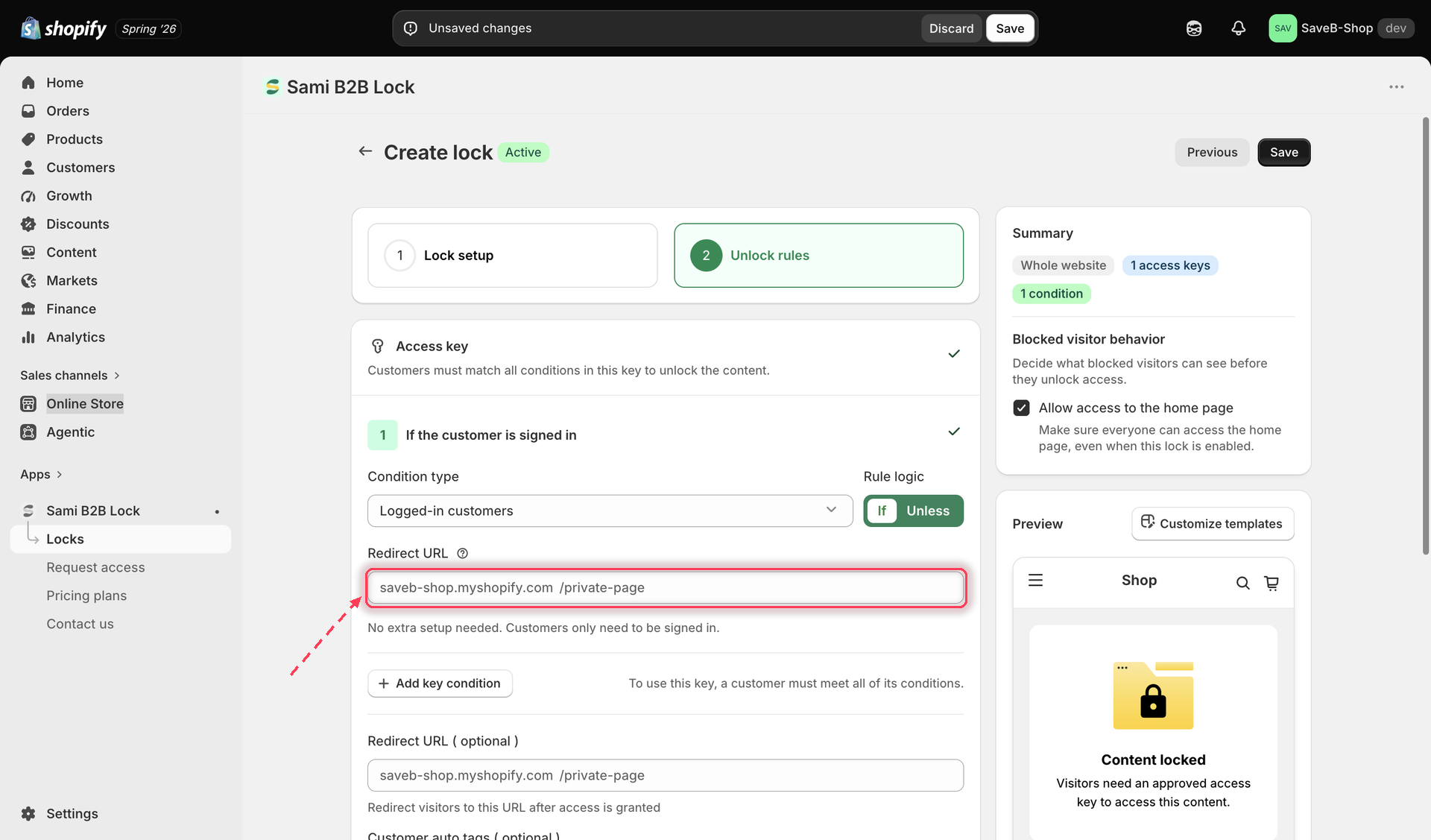
  1. Choose or enter the destination page or URL.

  2. Click Save.

Once a visitor satisfies every rule in that access key, they're sent to the URL you set instead of staying on the unlocked content.

Redirect on deny

Reach this setting

  1. In the same lock, on the Unlock rules tab, open an individual rule inside an access key in the main column.

  2. Find that rule's own Redirect URL field.

A rule's individual Redirect URL field with a tooltip explaining that visitors without access will be redirected there.
Each rule has its own Redirect URL, used only when that specific rule denies the visitor.
  1. Choose or enter a destination for visitors who fail that rule specifically.

  2. Click Save.

If a rule's Redirect URL is left blank, a visitor who fails it simply sees the lock's default access-denied message instead of being redirected. Because each rule has its own redirect, you can send visitors to different destinations depending on exactly which condition they failed — for example, a "must be logged in" rule could redirect to your login page, while a "must be a wholesale customer" rule redirects to your wholesale application form.

Last updated

Was this helpful?