> For the complete documentation index, see [llms.txt](https://docs.samita.io/llms.txt). Markdown versions of documentation pages are available by appending `.md` to page URLs; this page is available as [Markdown](https://docs.samita.io/samita-wholesale-b2b/volume-pricing/create-a-volume-pricing-based-on-product-quantity.md).
# Create a volume pricing based on product quantity
Discount a product automatically as customers buy more of it, using quantity tiers you define.
This is the most common type of volume pricing: the more a customer buys of a product, the lower the price per unit gets.
## Steps to manage
{% stepper %}
{% step %}
### Start a new rule
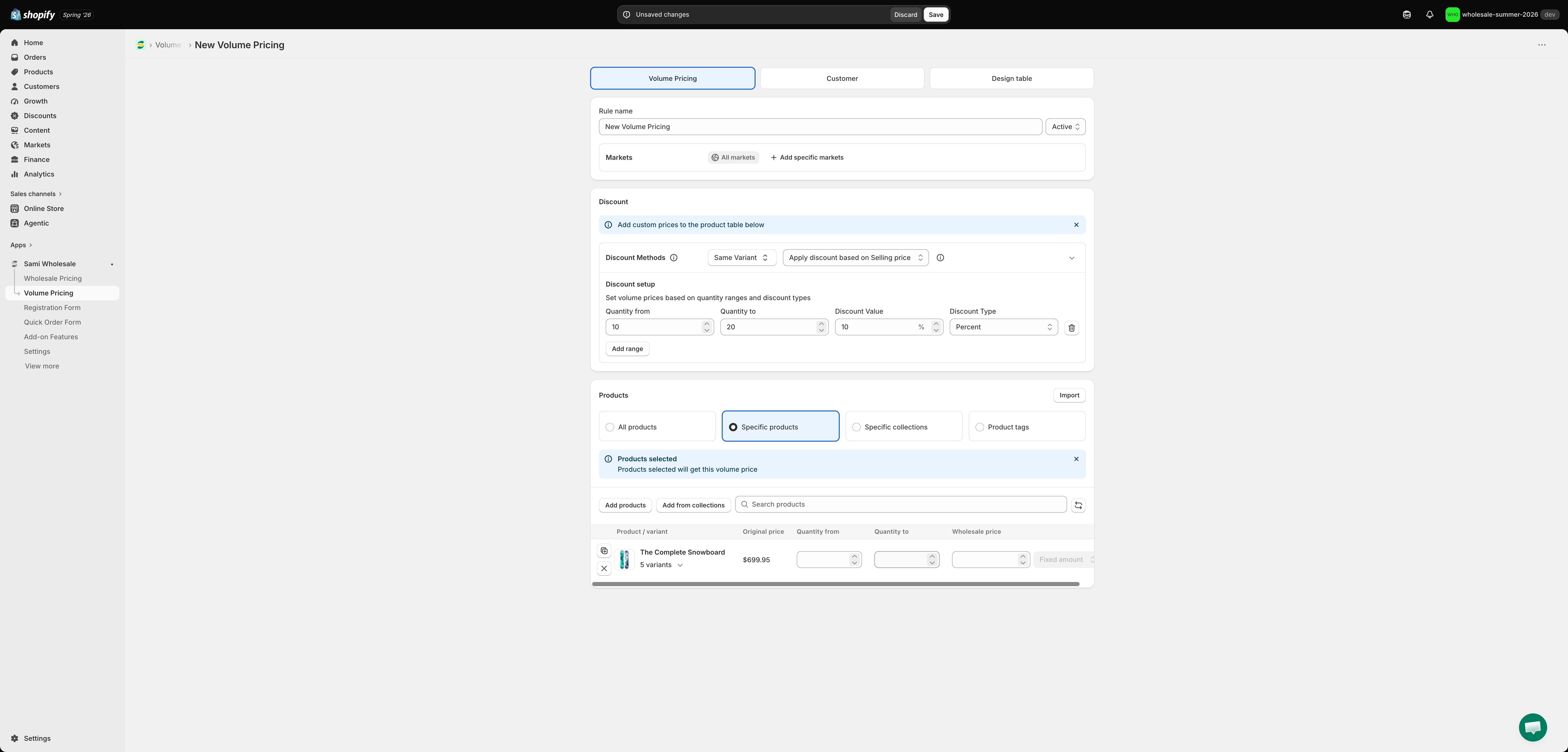
Open the app, click **Volume Pricing**, click **Add new volume pricing** (or **Create new volume pricing** if you already have rules), then choose **Quantity** in the **Select type** dialog.
{% endstep %}
{% step %}
### Name the rule and set its status
At the top of the **Volume Pricing** tab, name the rule in **Rule name**, then use the **Status** dropdown to choose **Active**, **Draft**, or **Schedule**. Choosing **Schedule** reveals **Start date** and **End date** fields so you can set when the rule turns on and off.
{% endstep %}
{% step %}
### Choose a market
In **Markets**, choose **All markets** or click **Add specific markets** and pick the ones you want.
{% endstep %}
{% step %}
### Set the discount method and pricing source
In the **Discount** section, under **Discount Methods**, choose **Same Variant**, **Mix Variants**, or **Mix Products** — this controls which items count toward each quantity tier. See [Discount Methods for Volume Pricing](/samita-wholesale-b2b/volume-pricing/discount-methods-for-volume-pricing.md) for details.
Next to it, use **Pricing source** to choose whether the discount is calculated from the product's Selling price or its Compare-at price. See [Choose pricing source](/samita-wholesale-b2b/volume-pricing/choose-pricing-source.md).
{% endstep %}
{% step %}
### Set up the quantity tiers
Still in the **Discount** section, under **Discount setup**, add your tiers — **Quantity from**, **Quantity to**, **Discount Value**, and **Discount Type** (**Percent**, **Amount**, or **New price**). Click **Add range** for more tiers. For example:
* 10–19 → 10% off
* 20–29 → 15% off
* 30+ → 20% off
The more a customer buys, the better the price they get.
{% endstep %}
{% step %}
### Choose which products it applies to
In **Products**, choose **All products**, **Specific products**, **Specific collections**, or **Product tags**. If you pick anything other than **All products**, a table appears below listing each matching product. You can optionally set a custom **Quantity from/to** and price for individual products or variants directly in that table, overriding the tiers set above just for them.
{% endstep %}
{% step %}
### Set customer eligibility
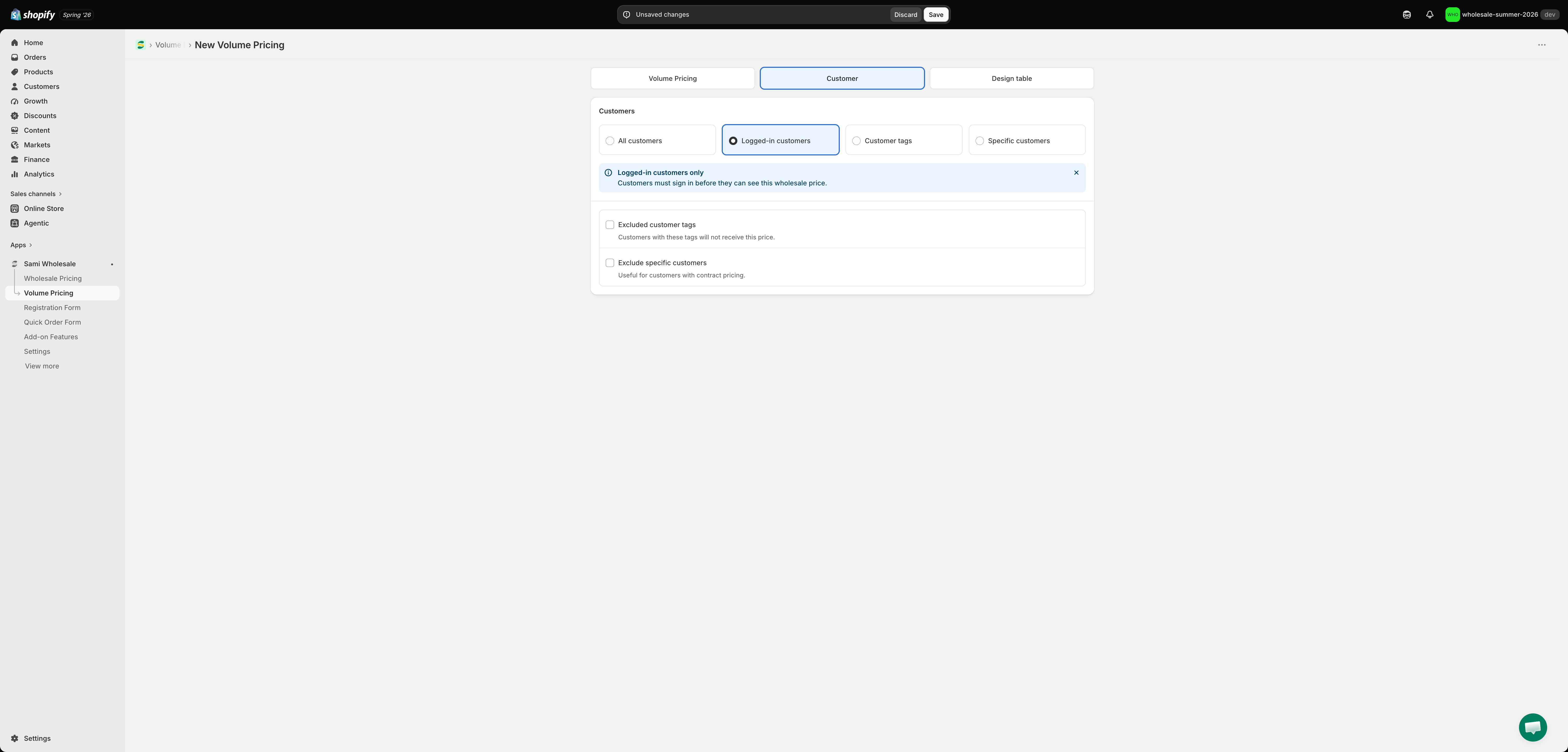
Click the **Customer** tab. Choose **All customers**, **Logged-in customers**, **Customer tags**, or **Specific customers**. Below that, tick **Excluded customer tags** or **Exclude specific customers** if you want to hide the price from certain customers (useful for customers on contract pricing).
{% endstep %}
{% step %}
### Design and preview the pricing table
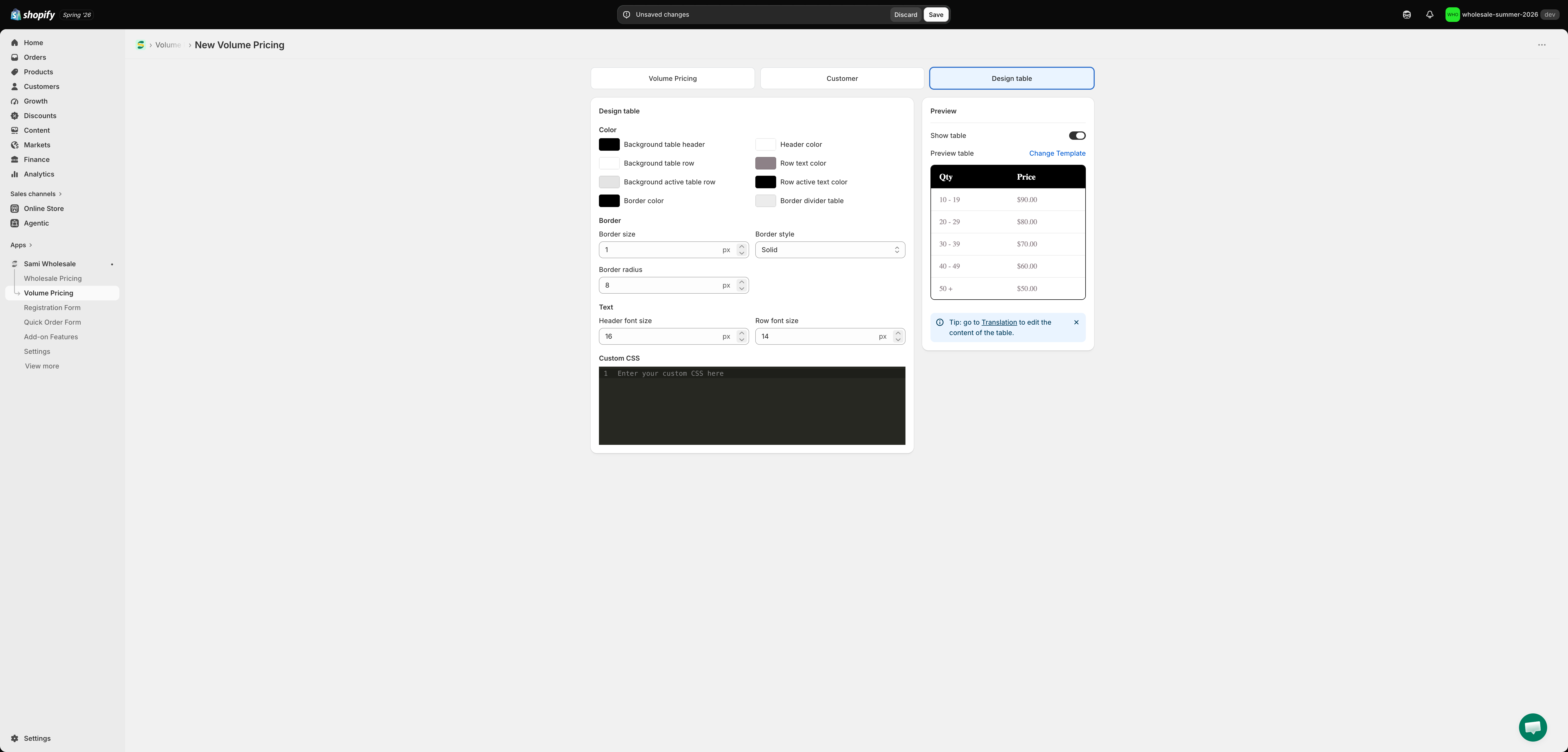
Click the **Design table** tab to control colors, borders, and text size for the table shown on your product pages, and to preview it live. Turn off **Show table** if you don't want the table displayed on the product page. Click **Change Template** to try a different table layout.
{% endstep %}
{% step %}
### Save
Click **Save** in the bar that appears at the top of the page once you've made changes.
{% endstep %}
{% endstepper %}
## Tutorial video
{% embed url="" %}
---
# Agent Instructions
This documentation is published with GitBook. GitBook is the documentation platform designed so that both humans and AI agents can read, navigate, and reason over technical content effectively. Learn more at gitbook.com.
## Querying This Documentation
If you need additional information that is not directly available in this page, you can query the documentation dynamically by asking a question.
Perform an HTTP GET request on the current page URL with the `ask` query parameter, and the optional `goal` query parameter:
```
GET https://docs.samita.io/samita-wholesale-b2b/volume-pricing/create-a-volume-pricing-based-on-product-quantity.md?ask=&goal=
```
`ask` is the immediate question: it should be specific, self-contained, and written in natural language.
`goal` is optional and describes the broader end goal you are ultimately trying to accomplish on behalf of the user. GitBook uses it to tailor the answer towards what is most useful for that goal.
The response will contain a direct answer to the question and relevant excerpts and sources from the documentation.
Use this mechanism when the answer is not explicitly present in the current page, you need clarification or additional context, or you want to retrieve related documentation sections.