
Quote history page
Let logged-in customers look back at the quotes they have already sent, on the quote history page.
The Quote history page is the second storefront page the app uses. On your storefront it is titled “Quote history” and sits at /pages/quotes-history, and the app describes it as: “Shows a logged-in customer’s past quotes.”
You do not have to create it. The app adds it to Online Store > Pages when you install it, alongside the Request for quote page, and points the setting at it for you.
It gives customers a record of their own requests, which saves them emailing you to ask where a quote got to.
Check the page settings
Section titled “Check the page settings”-
Open the Customize editor
Section titled “Open the Customize editor”Go to Quote settings. On the Request a Quote page, click Customize.
-
Open the Quote cart page tab
Section titled “Open the Quote cart page tab”Both storefront pages are listed on this tab, not on Quote form.
-
Confirm the page under Pages
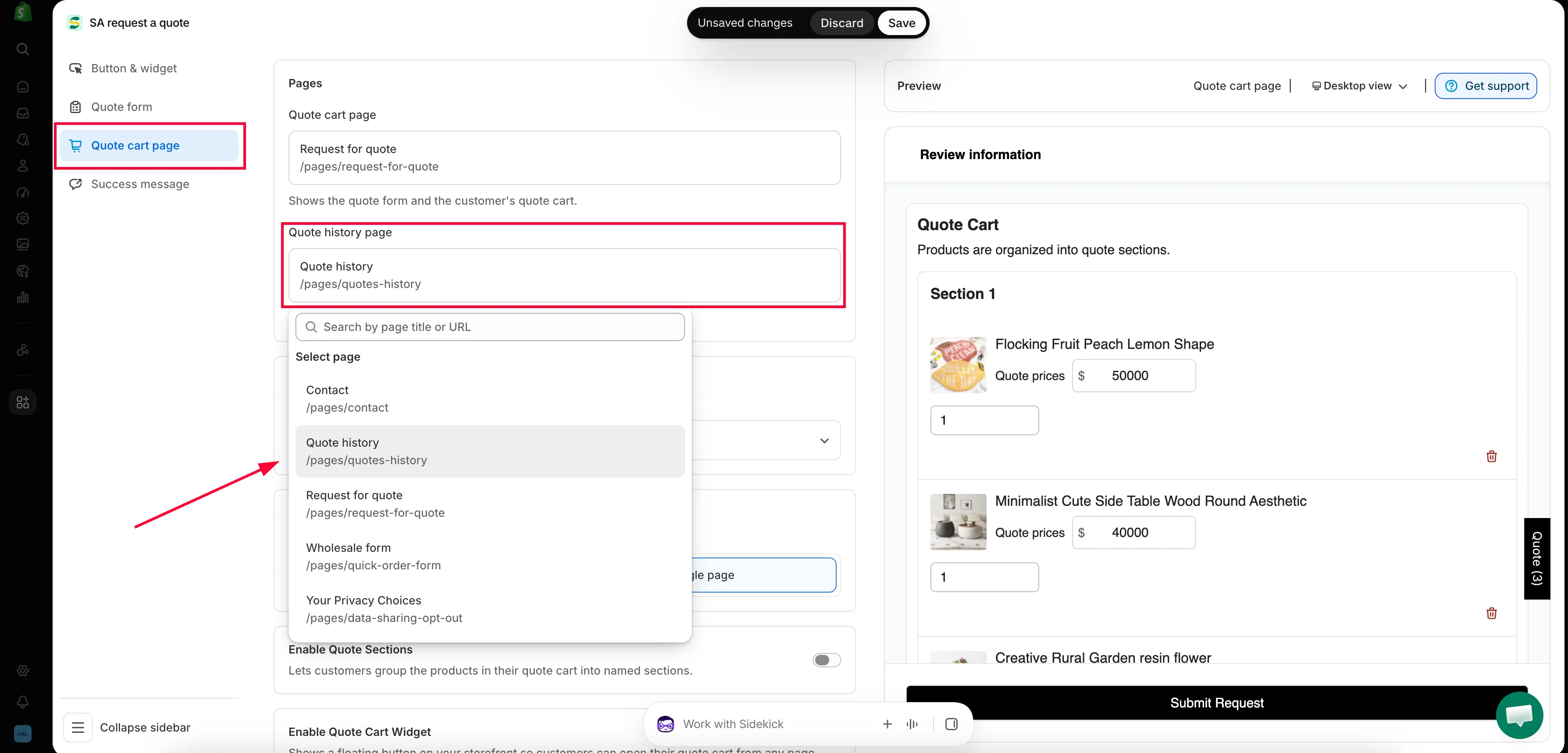
Section titled “Confirm the page under Pages”Under Pages, Quote history page shows the page title “Quote history” and the path
/pages/quotes-history, with a Published or Draft badge beside it.Click the setting to change which page it points at. A panel opens with a Search by page title or URL box and a Select page list of your store’s pages, each showing its title, its path and its status badge. Pick one and it replaces the current choice. If nothing matches what you typed, the panel offers Create page automatically instead.
Make it reachable
Section titled “Make it reachable”Nothing links to the page until you add it to a menu yourself.
-
Add a menu item
Section titled “Add a menu item”Add a Quote history item to your navigation, pointing at the “Quote history” page — see Add quote links to your menu for the exact clicks.
The traditional home for it is your store’s Header menu — the menu most Shopify themes call Main menu. But a footer or account menu is usually the better place, since only logged-in customers can use it and a header link that half your visitors cannot use is wasted space.
-
Ask a customer to sign in
Section titled “Ask a customer to sign in”They sign in to their customer account on your store.
-
Open the page
Section titled “Open the page”They click the menu item you added. The page “Shows a logged-in customer’s past quotes”, so they can look back at what they asked for.
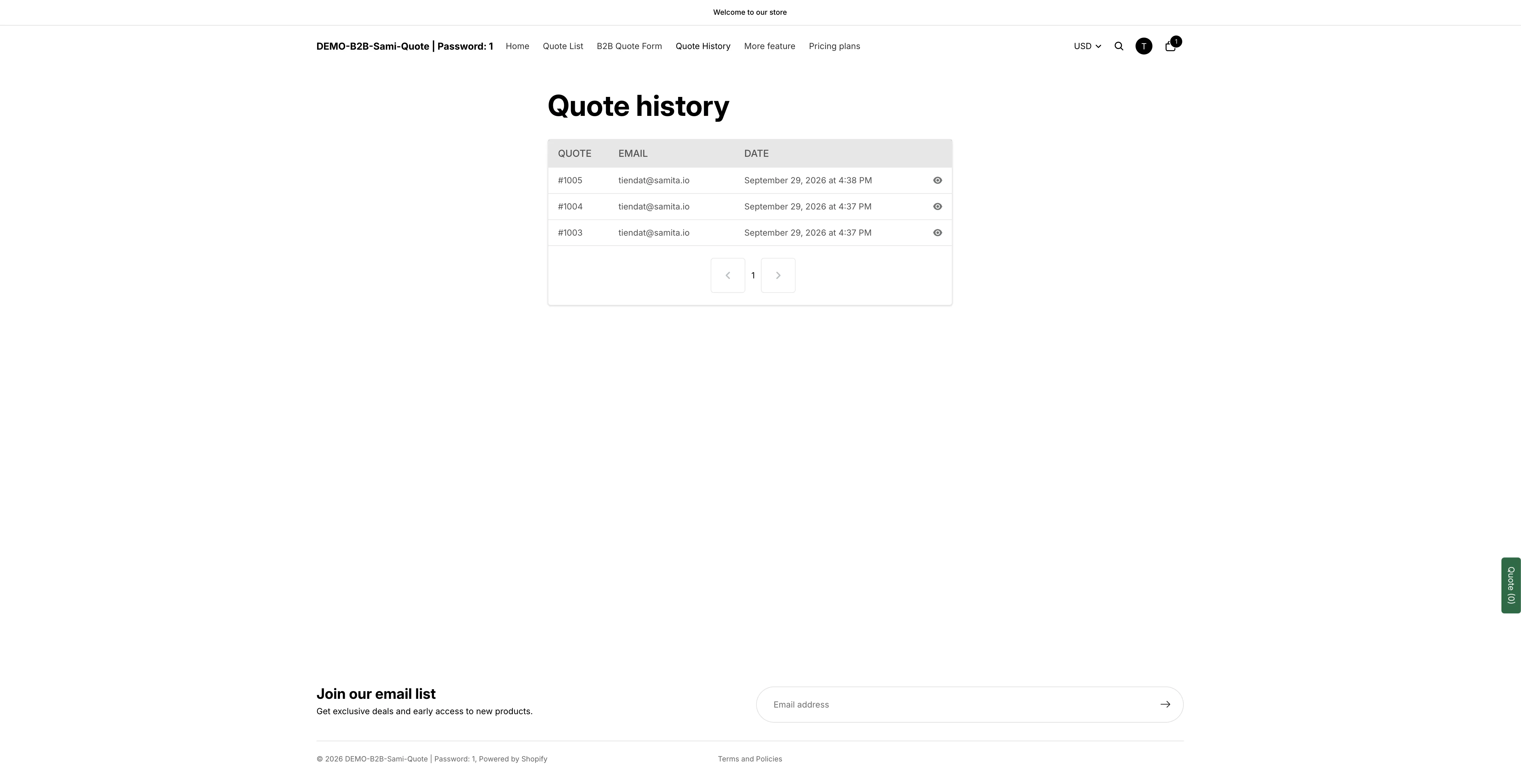
Past requests, with their dates and status.
If the page looks wrong
Section titled “If the page looks wrong”| What you see | What to check |
|---|---|
| The page is empty for a customer | They are signed out. Check this before anything else — it is the most common cause by a distance. |
| The page is empty for you, signed in as yourself | Your own account has not sent any quotes. Send a test one from the storefront as that customer. |
| The page is Not Found | The page is Draft in Shopify, or it was deleted. Publish it, or point the setting at another page. |
| The page loads but shows none of the app's content | The app's <div class="rfq_history_page"></div> block was removed from the page content, or a leftover {rfq_history} token is still in there. See Troubleshooting. |
| No customer can find it | It is not in a menu. Nothing links to it until you add it. |
Why offer it
Section titled “Why offer it”| Benefit | Why it matters |
|---|---|
| Fewer "where's my quote?" emails | Customers can look up what they sent instead of asking you. |
| A record of what was asked for | Buyers can see exactly what went into a previous request. |
| A reason to create an account | Gives customers something concrete in return for signing up. |
A newer alternative
Section titled “A newer alternative”If your store uses Shopify’s new customer accounts, quotes can appear inside the account area itself rather than on a separate page. That is set up under the Customer account navigation item, and it brings Permission setting with it — “Set permissions that allow your customers to view, manage, or respond to their quotes.”
Either way the customer has to be signed in, so the choice is about where they look, not who can look. You can run both: the account area for customers who live in their account, and this page for the menu link that gets them there in one click. See Quotes in customer accounts.
Next steps
Section titled “Next steps”- Add quote links to your menu — add the page to your navigation
- Quotes in customer accounts — show quotes in Shopify customer accounts
- Request a Quote page — the page customers send quotes from